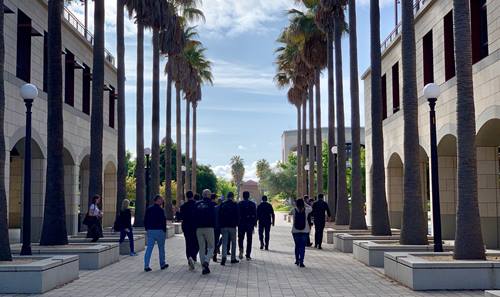
Silicon Valley was rewarded at the Nobel Prizes in 2020
Research has not gotten the same attention as usual in the US. The universities have been empty due to COVID-19 and the news coverage has been dominated by the American election. However, this does not mean that research has stalled. As is the case with so many other sectors, research and education in the US have been running at full speed, which was reflected in October’s Nobel Prize award ceremony.
Especially the universities of Silicon Valley, who were awarded with Nobel Prizes in chemistry, physics, economy, and received a surprise in literature.
Gene editing, new auction formats and creative writing
Professor Jennifer A. Doudna of Berkeley University of California, along with Emmanuelle Charpentier of the Max Planck Institute in Berlin, received the Nobel Prize in Chemistry for the discovery of the gene-editing tool: CRISPR. The CRISPR-technology enables researchers to cut and edit the DNA of humans, animals and plants. It can be used to treat diseases and to develop genetically modified crops and microorganisms, which will be indispensable tools in the green transition.
The two Stanford professors Paul Milgrom and Robert Wilson received the Nobel Prize in Economics for their auction theories and the development of entirely new, more advanced auction formats. Auctions are a mechanism that solves an allocation problem, and they are used today in a wide range of areas, from the pricing of prescription drugs and electricity to the placement of advertisements on websites. These auctions will also play an important role in the fight against climate change in the allocation of emission rights.
This year, Stanford also had - perhaps a little surprisingly – a share of the Nobel Prize in Literature, which went to the American author, Louise Glück. Louise Glück is a visiting professor at Stanford and has been part of the university's Creative Writing Program. This Nobel Prize helps to emphasize that Stanford is much more than science and technology.
Basic research is the engine of Silicon Valley
There are currently 29 living Nobel laureates divided between UC Berkeley and Stanford, which emphasize that the Bay Area is one of the greatest scientific areas in the world, while the area is an innovative hub for global technology companies, start-ups and venture capital.
It is to a great extent the research and the universities that are the engine of Silicon Valley. They constitute the educational foundation of the many researchers and specialists who work in the tech giants' development departments, develop tomorrow's technologies, or start their own businesses. The research is the source of many groundbreaking inventions that entrepreneurs, investors, and large companies subsequently develop into solutions that can be brought to consumers and help solve society's major challenges.
The CRISPR technology, for example, is already in use, even though it is only a few years old. The Danish biotech company SNIPRBIOME, which raised DKK 350 million is just one of several examples of how Nobel Prize research in California is transformed and becomes the basis for new CRISPR-companies in Denmark. SNIPRBIOME uses CRISPR technology to develop new antibacterial drugs that can solve the problem of antibiotic resistance, which kills millions of people every year.
The CRISPR-technology will also be used in the green transition and the fight against climate change. The technology can be applied when developing new bio-based and degradable materials and to reduce CO2-emissions from agriculture and industrial processes. The Nobel Prize research at UC Berkeley and the surrounding environment constitute obvious international collaborators for Denmark when the green research strategy and the green partnerships are to be established.
Use Denmark’s partnership agreements with the universities in Silicon Valley
At the Innovation Centre in Silicon Valley (ICDK Silicon Valley), we have a close dialogue with
SUNCAT energy research center at Stanford and the universities in the CITRIS-collaboration (which includes UC Berkeley, Davis, Merced and Santa Cruz). We pave the way for Danish researchers to collaborate with American researchers in areas such as capture, storage and utilization of C02 as well as energy storage and conversion. All themes that are central to the Danish green research strategy. In 2020, ICDK Silicon Valley has built up a strong network and in-depth knowledge of the entire green ecosystem within entrepreneurship in Silicon Valley.
We bring the knowledge from Silicon Valley to Danish players through study visits, roundtables, seminars, learning academies, and master classes. All tools to link Danish research and technology development within the central themes of the research strategy to the international green transition, while getting an international perspective on Danish efforts and solutions.
At ICDK Silicon Valley, we are ready to assist the work of implementing the four research missions, and to contribute to the fight against climate change and the green transition.
Contact Reach out to learn more
read more related content
-

The next generation of education - The booming US market
EdTech Digitalization Entrepreneurship Research & EducationThe digitization of the educational sector and the need for EdTech solutions has increased and gained speed. EdTech is here to stay, and both the American Investors and the educational industry are very well aware of it.
26.08.2020Read more -
green research Find research and collaboration opportunities in California
Research & Education Energy Going GreenResearch and development of new green technologies is a key focus in Denmark, as it plays a crucial role in achieving Denmark’s goal of reducing greenhouse gas emissions with 70 percent by 2030. But climate challenges are global and like Denmark, California has a strong focus on research within the green area. The shared focus areas and comparative research strongholds in Denmark and California equal great opportunity for learning and collaboration.22.06.2020Read more -
Entrepreneurship academy How entrepreneurship is supported at US universities
In the US, universities such as MIT and Stanford have played a crucial role in creating the world's leading innovation environments in Boston and Silicon Valley. A delegation of Danish universities and organizations visited the two cities during an "Entrepreneurship Academy," facilitated by Innovation Centre Denmark. Read the key messages from the trip and learn how US universities support entrepreneurship.26.06.2019Read more